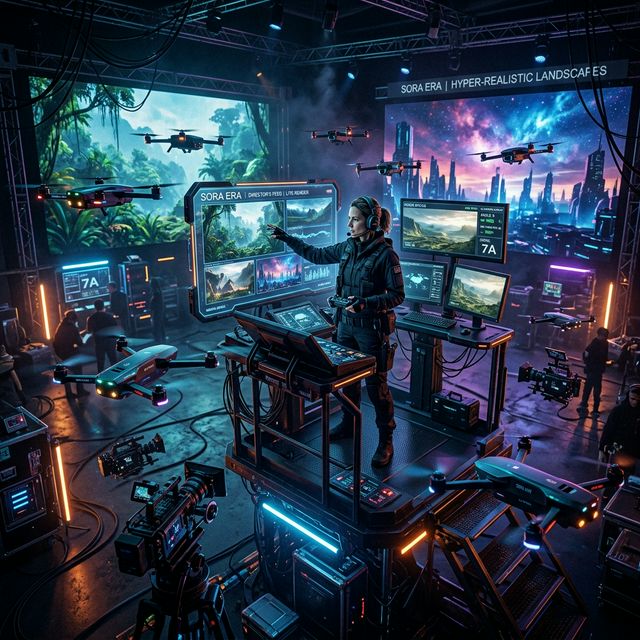
The Death of the Render Farm
For a century, filmmaking was additive. You added a set, you added a light, you added an actor, you added a digital effect. This additive model was fundamentally un-scalable. It was bound by the laws of physics, labor unions, and the thermal limits of silicon. As tech guys, we look at that and see a bug. A massive, bloated, legacy subroutine that was begging for a refactor. Sora, Kling, and Runway Gen-3 are that refactor. We're moving from 'the physics-based simulation'—where you have to calculate every photon reflecting off a chrome surface—to 'the latent probability'—where the model just knows what a 'cinematic chrome surface' looks like and predicts it.
This is the transition from 'Correctness' to 'Plausibility.' In the old world, if a shadow didn't follow the exact inverse square law, it was a mistake. In the new world, if it looks 'cool' and the tokens are consistent, it’s a hit. Our research into video models like Kling AI shows that the Diffusion Transformer Architecture is now achieving physics-aware motion at 30fps. We’re no longer calculating fluid dynamics; we’re 'prompting' them. The result is a 10,000x optimization in throughput. We’ve turned the 'blockbuster' from an event into a commodity.
The Optimization of the Auteur
There's a specific kind of dread in the halls of traditional studios. It's the dread of the 'Director-as-Auteur.' For decades, the director was the 'god' of the set, the singular vision that controlled every detail. But in the 'Sora Era,' the director is just a curator of outputs. A supervisor of the machine. It’s a cleaner, faster, more data-driven role. You don't have to explain your vision to five hundred tired artists; you just have to refine your embedding. You just have to tune the reward function until the machine produces the 'masterpiece' you want.
We’ve seen the benchmarks. Models like OpenAI's Sora can now handle up to 5-minute sequences with temporal consistency that would take an army of compositors months to achieve. When you have multi-camera 'Director Mode' continuity available as a standard API feature, the technical moat of Hollywood has officially dried up. We’re optimistic about the 'creator economy'—a trillion-dollar potential where every kid with a smartphone is a studio—but we're shaky on the consequence. Are we helping people tell stories, or are we just flooding the world with high-fidelity noise? Does a story still matter when it costs zero to tell?
Engineering the 'WOW' Factor
We don't talk about 'art' much in the office. We talk about 'outputs.' But we’ve realized that aesthetics can be engineered. By training models on the last 100 years of cinema, we’ve effectively mapped the 'cinematic latent space.' We know exactly which lens flares, which aspect ratios, and which color palettes trigger a 'prestige film' response in the human brain. We’ve automated the 'WOW' factor. We’ve turned the 'feel' of a movie into a set of hyperparameters.
I was watching a demo for Runway Gen-3's Turbo inference last week. A developer typed: 'Slow tracking shot of a neon-drenched Tokyo street, 35mm grain, anamorphic lens flare, raining.' In six seconds, the screen was filled with a shot that five years ago would have won a cinematography award. My reaction wasn't awe. It was 'cool, the API is responding within SLA.' The magic is gone because we’ve seen the code. We know that shot is just a series of weights and biases finding their global minimum. It’s perfect, and that perfection is slightly nauseating because it's so effortless.
But here’s the shaky optimism: if the visual fidelity is now a solved problem, what’s left? What remains is the vision. We’ve removed the technical barrier, so now the only bottleneck is the human heart. Or at least, the human's ability to 'prompt' the heart. We’re in a world of 'Un-bottlenecked universal storytelling.' We can now failed faster, iterate more, and explore every possible timeline of a story. We’re building the first truly infinite library of human imagination. But I still can’t shake the feeling that we’re just building a better way to ignore our own reality.
The Disruption of Labor
Let's be real about the workers. The junior VFX artist, the compositor, the rotoscoper—these roles are being deprecated. They’re like horse-and-buggy drivers in the age of the Model T. We’re not happy about the human cost, but we’re technologists. We can't ignore the scaling efficiency. Why pay for a thousand hours of manual rotoscoping when Meta's SAM 2 (Segment Anything Model 2) can do it for free in three seconds? The 'craft' was just a technical limitation that we've finally patched. The people who defined themselves by their 'hands' are in for a rough decade. The people who define themselves by their 'ideas' and their 'data-literacy' are the new royalty.
We’re building a 'Disruption Stack' for the entertainment industry. It’s a full-stack refactor of how humans consume visual information. From 3D Neural Reality to AI Production Flow, we’re removing the 'friction' of the physical world. We’re building a future where the 'film' is just a raw stream of data that the user interacts with in real-time. This is 'Generative Native' storytelling. No more locked masters. No more release dates. Just a continuous, latent-space simulation. It’s the ultimate product-market fit for human attention.
The Final Commit
We’re tech bros, and we’re here to port Hollywood to the cloud. We're here to make every frame a commodity and every director an operator. It’s going to be a bloodbath for the legacy ecosystem, and my heart goes out to the people who think they’re special because they can carry a heavy camera. But the efficiency gap is too big to ignore. The render farm is dead. The lens is a legacy feature. The data is everything. We’re optimistic about the scale, the power, and the infinite possibilities. But some nights, looking at the flicker of a generated nebula on my monitor, I miss the time when movies were actually hard to make. But hey, at least the cloud bill is predictable now.
We’ve fixed the bug of the visual world. Let's see what the users do with the patch.